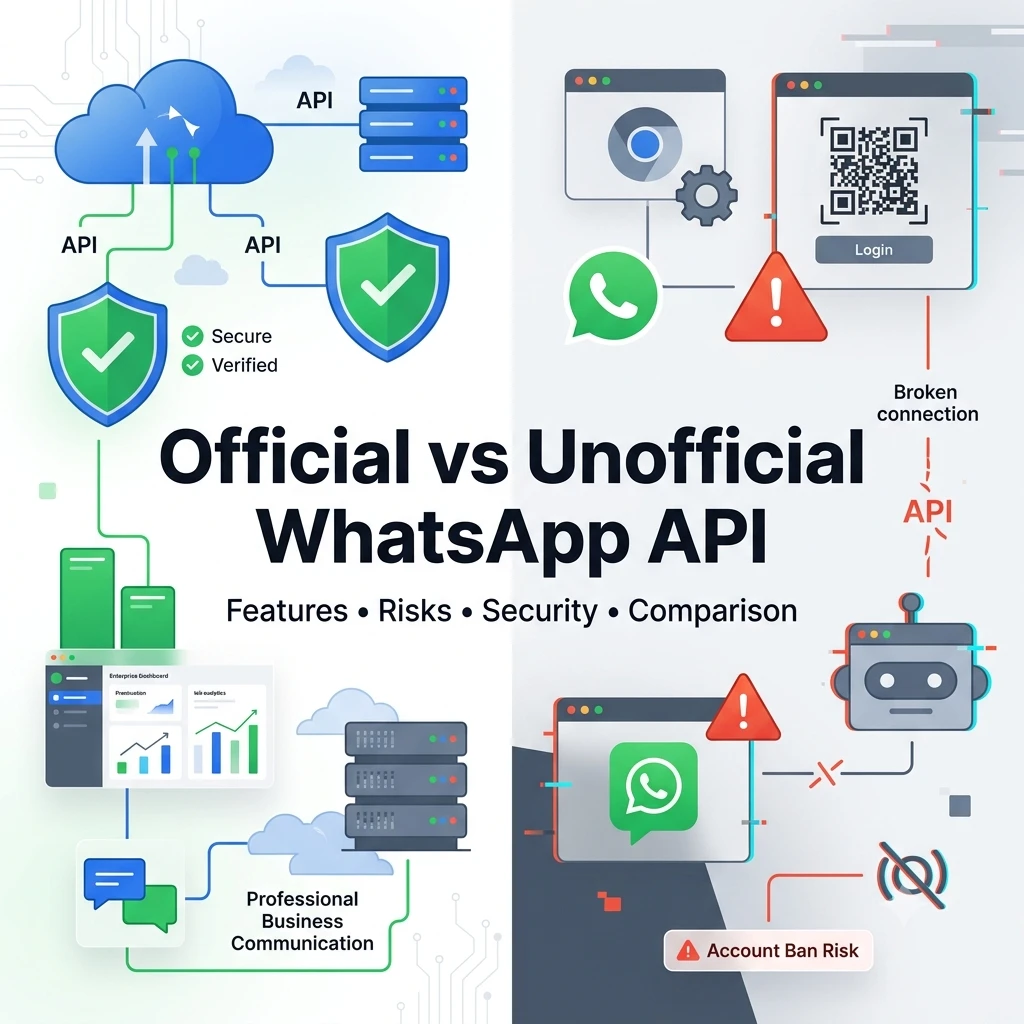

Official WhatsApp Cloud API vs Unofficial WhatsApp API
If you’re planning to build a WhatsApp chatbot, CRM integration, customer support system, or marketing automation platform, one of the first questions you’ll face is:
Should I use the Official WhatsApp Cloud API or an Unofficial WhatsApp API?
The answer depends on your business goals, scalability requirements, compliance needs, and risk tolerance.
In this guide, we’ll compare both options in detail, explain the risks of unofficial APIs, and help you decide which solution is right for your business.
Quick Answer
Use the Official WhatsApp Cloud API if:
- You are building a production application.
- You want long-term stability.
- You want to avoid account bans.
- You need official support from Meta.
- You require scalable customer communication.
Consider an Unofficial WhatsApp API only if:
- You’re experimenting or building a prototype.
- You need features not available in the official API (such as group management or existing chat access).
- You understand and accept the operational and compliance risks.
What is the Official WhatsApp Cloud API?
The Official WhatsApp Cloud API is Meta’s officially supported platform that allows businesses to send and receive WhatsApp messages using secure REST APIs and webhooks.
It is designed specifically for business communication and powers:
- Customer Support
- Chatbots
- Order Notifications
- Authentication (OTP)
- Appointment Reminders
- Marketing Campaigns
- CRM Integrations
- AI Assistants
Unlike browser automation tools, the Cloud API communicates directly with Meta’s infrastructure.
What is an Unofficial WhatsApp API?
An Unofficial WhatsApp API connects to WhatsApp through WhatsApp Web using browser automation or reverse-engineered protocols.
Popular libraries include:
- Baileys
- whatsapp-web.js
- OpenWA
- Venom
- WPPConnect
These solutions are widely used by developers because they’re easy to start with and provide access to features unavailable in the official API.
However, they are not approved or supported by Meta.
Official WhatsApp Cloud API vs Unofficial API
| Feature | Official Cloud API | Unofficial API |
|---|---|---|
| Meta Approved | ✅ Yes | ❌ No |
| Official Support | ✅ Yes | ❌ No |
| Risk of Account Ban | Very Low (when policy-compliant) | High |
| Stability | Excellent | Moderate |
| Webhooks | ✅ Yes | Depends |
| Interactive Messages | ✅ Yes | Limited |
| Template Messages | ✅ Yes | No |
| Media Support | ✅ Full | Usually Yes |
| Customer Service Window | Supported | Not Applicable |
| Marketing Messaging | Supported | Risky |
| Group Support | ❌ No | Usually Yes |
| Read Existing Chats | ❌ No | ✅ Yes |
| QR Code Login | ❌ No | ✅ Yes |
| Business Verification | Supported | Not Required |
| Scalability | Excellent | Limited |
Advantages of the Official WhatsApp Cloud API
1. Officially Supported by Meta
The Cloud API is maintained by Meta, ensuring reliable updates, documentation, and compatibility.
2. Lower Risk of Account Suspension
Businesses that follow WhatsApp’s Business Messaging Policy have a significantly lower risk of enforcement actions compared to browser automation.
3. Enterprise-Ready Features
The Official API supports:
- Text messages
- Images
- Videos
- Documents
- Audio
- Interactive Buttons
- List Messages
- Product Catalogs
- Marketing Templates
- Authentication Templates
- Utility Templates
- Delivery & Read Status
- Webhooks
4. Built for Scale
Whether you’re sending hundreds or millions of messages, the Cloud API is designed to support business growth.
5. Better Security
Authentication uses secure API tokens instead of browser sessions.
No QR scanning.
No browser automation.
No session file management.
Advantages of Unofficial WhatsApp APIs
Unofficial APIs are popular because they provide functionality that the official API intentionally doesn’t expose.
Advantages include:
- QR Code Login
- Uses an existing WhatsApp number
- Reads previous chats
- Group messaging
- Group management
- Status access
- Personal WhatsApp automation
- Open-source ecosystem
These capabilities are attractive for prototypes, internal tools, or personal automation.
Risks of Using an Unofficial WhatsApp API
1. High Risk of Account Ban
Because unofficial APIs automate WhatsApp Web instead of using Meta’s supported interfaces, automated behavior may trigger enforcement.
Possible outcomes include:
- QR logout
- Temporary suspension
- Session invalidation
- Permanent number ban
Higher automation volumes generally increase this risk.
2. No Official Support
If WhatsApp changes its web application, there is no official support channel.
Developers depend entirely on community maintainers for fixes.
3. Frequent Breaking Changes
WhatsApp Web updates regularly.
These changes may cause:
- QR login failures
- Message delivery issues
- Media upload failures
- Event handling changes
- Session disconnects
4. Security Concerns
Most unofficial APIs store browser sessions locally.
If these files are compromised, attackers may gain access to the connected WhatsApp account.
5. Difficult to Scale
Managing many browser sessions becomes operationally complex.
Common challenges include:
- Browser crashes
- High memory usage
- Session expiration
- Multiple reconnects
6. Compliance Risks
Unofficial APIs are not approved by Meta and may violate WhatsApp’s Terms of Service.
Organizations should evaluate the legal, contractual, and operational implications before using them in production.
Limitations of the Official WhatsApp Cloud API
The Official API also has intentional limitations.
These include:
- Conversation-based pricing
- Approved templates required outside the customer service window
- No group messaging
- No access to existing personal chats
- No WhatsApp Status management
These are platform design choices rather than technical shortcomings.
Which API Should Your Business Choose?
Choose the Official WhatsApp Cloud API if you:
✅ Build CRM software
✅ Build SaaS products
✅ Provide customer support
✅ Send notifications
✅ Build AI chatbots
✅ Need reliable delivery
✅ Want long-term stability
Choose an Unofficial API only if you:
- You’re experimenting.
- You’re building an internal tool.
- You need access to groups.
- You accept possible downtime and account restrictions.
Frequently Asked Questions (FAQs)
Is the Official WhatsApp Cloud API free?
Meta pricing depends on conversation categories and volume. Check Meta’s latest pricing for current rates.
Can the Official WhatsApp API get my number banned?
Accounts using the Official WhatsApp Cloud API and following Meta’s policies have a much lower risk of enforcement compared to unofficial browser automation.
Why do people still use unofficial WhatsApp APIs?
Because they offer capabilities such as:
- Reading existing chats
- Group messaging
- QR login
- Personal WhatsApp automation
These features are intentionally unavailable in the official API.
Is whatsapp-web.js legal?
The library itself is open source, but using it to automate WhatsApp Web is not an officially supported integration. Businesses should review WhatsApp’s Terms of Service and evaluate the associated risks before deploying it.
Can I send bulk WhatsApp messages using the Official API?
Yes, businesses can send outbound messages using approved message templates and must comply with WhatsApp’s messaging policies.
Which API is best for CRM integration?
The Official WhatsApp Cloud API is generally the preferred choice because it provides webhooks, scalability, security, and long-term platform support.
Final Verdict
For production applications, customer communication platforms, CRM systems, AI assistants, and enterprise automation, the Official WhatsApp Cloud API is the recommended approach. It offers better reliability, scalability, security, and a supported integration path.
Unofficial APIs can be useful for prototypes or specialized automation scenarios, particularly when access to groups or existing chats is required. However, they introduce significant operational, security, and compliance risks that should be carefully considered.
At Wabotick, we build solutions on the Official WhatsApp Cloud API to help businesses create reliable, secure, and scalable WhatsApp experiences that are designed for long-term growth.